Hybrid Navigation System
A reinforcement-learning navigation R&D project pairing Python AI flexibility with a Rust performance core, benchmarking Q-learning and A* pathfinding across both languages via PyO3.
3000
training episodes per Q-learning run
Python ↔ Rust
A* speedup benchmark via PyO3
3 layers
simulation, core & analytics
[ role ] Sole engineer · R&D prototype
Project specs
Tech Stack
R&D Focus
Reinforcement Learning & Performance Engineering
Complexity
An R&D prototype exploring the synergy between high-level AI flexibility (Python) and low-level execution performance (Rust). It trains a navigation agent with Q-learning, solves the same grid with A*, and benchmarks a Rust implementation of A* against its Python counterpart to quantify the speedup.
Problem
Reinforcement learning and pathfinding are easy to prototype in Python but slow at scale, while Rust is fast but cumbersome for rapid experimentation. The goal was to get the best of both: keep training and environment logic flexible in Python, while pushing performance-critical pathfinding into Rust — and measure the difference rigorously.
Approach
- › Simulation layer (the “brain”): A
GridEnvenvironment, a Q-learning agent trained over 3,000 episodes, and a classical A* search — all in Python. - › Performance core (the “engine”): A high-speed Rust implementation of A*, compiled to an importable
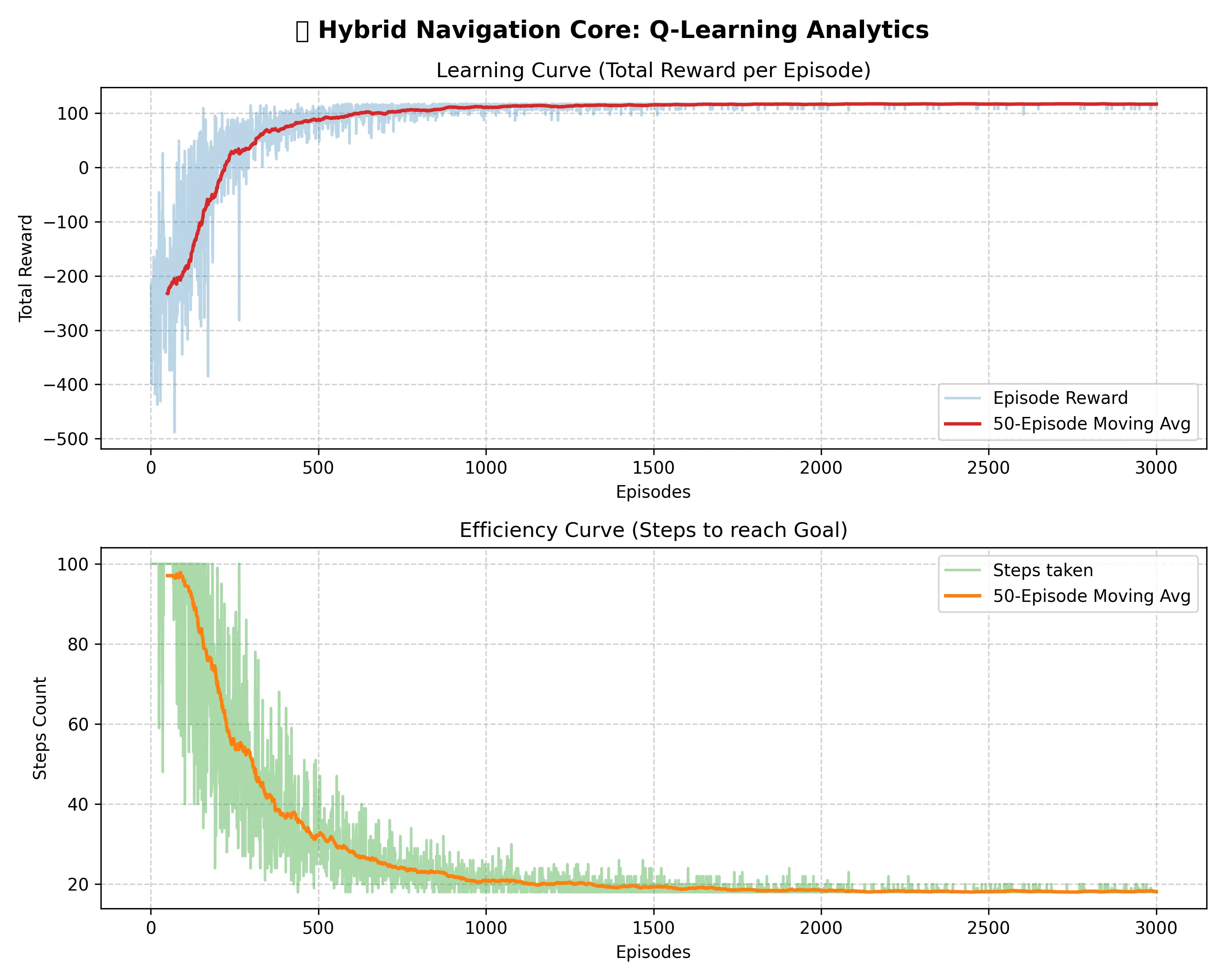
astar_rustmodule via PyO3 and maturin (maturin develop --release). - › Analytics layer (the “observer”): Logs episode rewards/steps, calculates convergence metrics, and renders training curves and benchmark comparisons.
- › Benchmarking flow: Generates a 100×100 grid, runs both the Python and Rust A* implementations, measures time and nodes expanded, and computes the speedup factor.
Outcome
- › End-to-end training pipeline producing
training_metrics.json(convergence summary) andtraining_curves.png(learning visualization). - › A reproducible head-to-head benchmark isolating the cost of the algorithm’s host language.
- › A clean three-layer separation (simulation, Rust core, analytics) with explicit module dependencies.
Stack notes
Python handles the RL loop and orchestration (NumPy, pandas, Matplotlib, seaborn for analysis). The Rust crate ( astar_rust ) is a cdylib exposed to Python through PyO3’s extension-module and built with maturin. pytest covers the shared logic.